
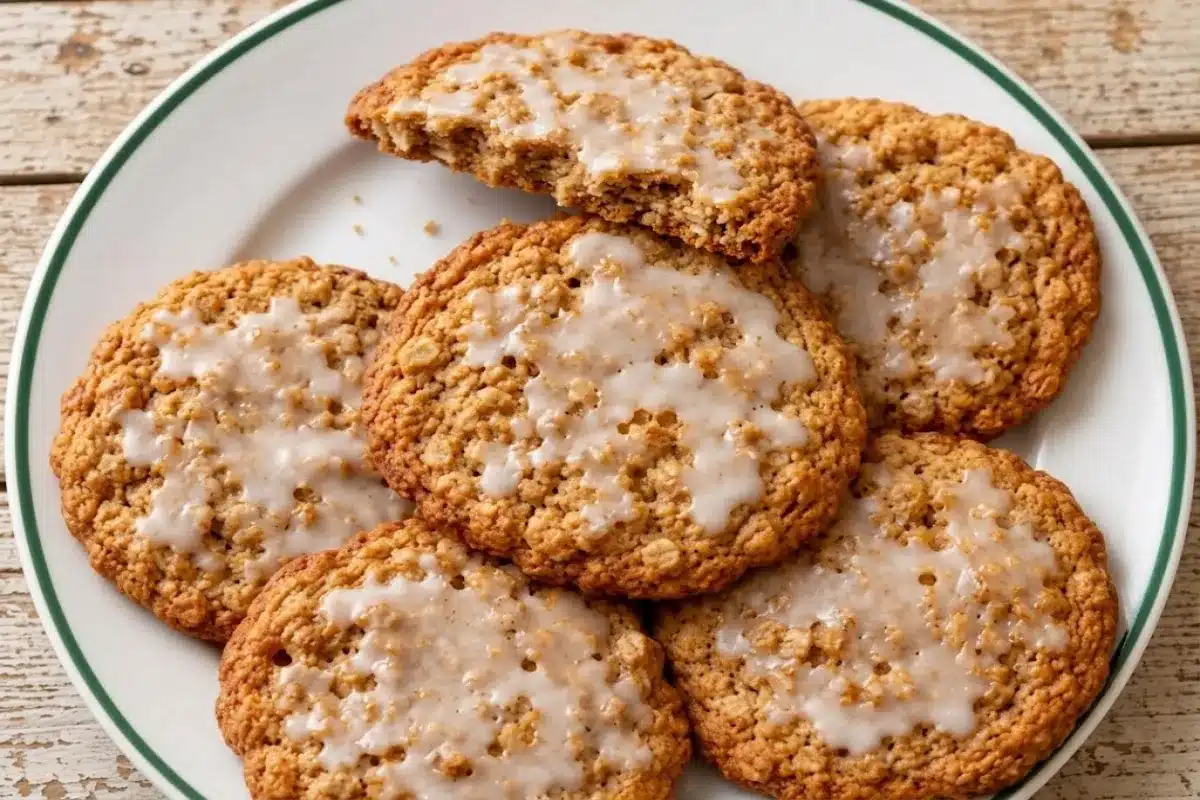
Warm cinnamon, chewy edges, and a thin vanilla icing that settles into every little ridge. These nostalgia-packed cookies bring back all the classic bakery-style charm with a sweet, crackled finish!
Soft White Chocolate Cranberry Cookies
Table of Contents
The Science Behind Old-Fashioned Iced Oatmeal Cookies
- Pulse-Grinding & Surface Ridge Engineering: Pulsing rolled oats in a processor creates irregular coarse fragments rather than fine oat flour or whole intact flakes. These uneven fragments swell during baking, creating a rough, craggy top surface designed to catch and hold thin icing.
- Molasses Invert Sugar & Moisture Retention: Adding unsulphured dark molasses introduces invert sugars (fructose and glucose) that bind water and resist crystallization. This ensures the cookie interior stays chewy and soft beneath the crisp, set icing layer.
- Surface Tension Mechanics of Top-Dipping: Whisking a high-viscosity powdered sugar glaze and shallowly dipping only the topmost ridges leaves the deeper fissures un-glazed. As water in the icing evaporates, a delicate sugary crust sets across the peaks while highlighting the spice-tinted cracks beneath.
| Prep Time | Chill Time | Bake Time | Yield | Category |
| 20 mins | 45 mins | 11–12 mins | ~28 cookies | Classic / Bakery |
Ingredients
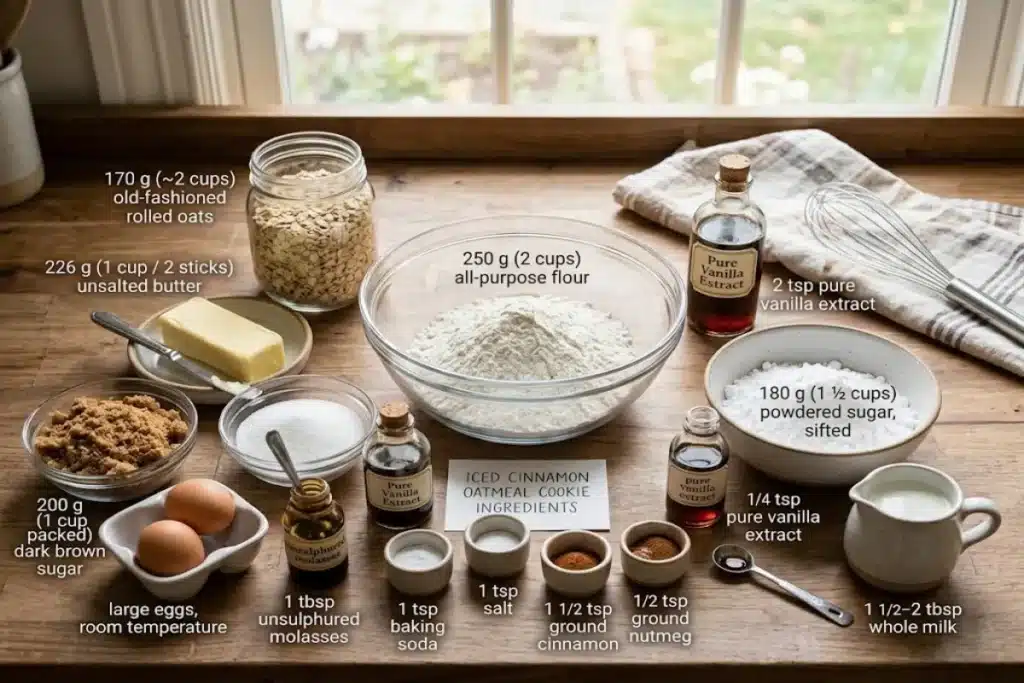
For the Cookie Dough:
- 170 g (~2 cups) old-fashioned rolled oats
- 250 g (2 cups) all-purpose flour
- 1 tsp baking soda
- 1 tsp salt
- 1 1/2 tsp ground cinnamon
- 1/2 tsp ground nutmeg
- 226 g (1 cup / 2 sticks) unsalted butter, softened
- 200 g (1 cup packed) dark brown sugar
- 100 g (1/2 cup) granulated sugar
- 2 large eggs, room temperature
- 1 tbsp unsulphured molasses (not blackstrap)
- 2 tsp pure vanilla extract
For the Vanilla Icing:
- 180 g (1 1/2 cups) powdered sugar, sifted
- 1/4 tsp pure vanilla extract
- 1 1/2–2 tbsp whole milk
Step-by-Step Instructions
1.Pulse Rolled Oats:Pulse 5 to 7 times only.
Place the 170g of old-fashioned oats into a food processor or blender. Pulse 5 to 7 times until coarsely broken up into varied fragments. Do not process into a fine oat flour!
2.Whisk Dry Ingredients:Ensures uniform spice distribution.
In a medium bowl, whisk together the pulsed oats, all-purpose flour, baking soda, salt, ground cinnamon, and nutmeg.
3.Cream Butter and Sugars:Beat 2 to 3 minutes until pale.
In a large mixing bowl, beat the softened butter, dark brown sugar, and granulated sugar together with an electric mixer until light, fluffy, and smooth.
4.Add Eggs, Molasses, and Vanilla:Emulsifies the lipid base.
Beat in the eggs one at a time, followed by the molasses and vanilla extract, until completely incorporated.
5.Combine Dry and Wet Mixtures:Low speed prevents tough dough.
Add the oat-flour mixture to the wet base and mix on low speed just until combined without overworking the dough.
6.Chill Dough for 45 Minutes:Hydrates oats and solidifies fats.
Cover the bowl tightly with plastic wrap and refrigerate the dough for 45 minutes until firm.
7.Preheat Oven and Portion Dough:Set oven to 350°F (177°C).
Preheat your oven to 350°F (177°C) and line two large baking sheets with parchment paper. Scoop 1 1/2-tablespoon portions (~30g) of chilled dough onto the sheets, leaving 3 inches between each cookie to accommodate spread.
8.Bake and Cool Completely:Bake 11 to 12 minutes.
Bake for 11–12 minutes, or until the edges are golden brown and the centers are set. Allow to rest on the baking sheets for 5 minutes before transferring to a wire rack to cool completely.
9.Whisk Vanilla Icing:Must be thick yet fluid.
In a shallow bowl, whisk together the sifted powdered sugar, 1/4 tsp vanilla, and 1 1/2 tablespoons of milk. Add remaining milk drop by drop if needed until the icing is smooth and thick.
10.Dip Cookie Tops and Set:Light surface dip leaves cracks visible.
Gently press the surface of each cooled cookie face-down into the icing so only the raised ridges catch the glaze. Lift straight up and let excess drip off. Place on a wire rack for 20 minutes to allow the icing to set completely.

Pro Tips for Baking Success
- Do Not Grind Oats to Flour: The secret to genuine mother’s-style iced oatmeal cookies is quick coarse pulsing! Intact bits of oats give the cookie its signature uneven, mountain-ridge surface.
- Cool Cookies FULLY Before Dipping: If cookies are even slightly warm, the icing will melt, turn clear, and run completely off into the deep cracks instead of sitting on the peaks.
- Keep Icing Viscous: The icing should be thick enough that it coats only the high ridges when lightly dipped. If it’s too thin, it fills every crevice and hides the rustic cookie texture.
Frequently Asked Questions
How are iced oatmeal cookies made?
Iced oatmeal cookies are made by pulsing rolled oats into coarse fragments, blending them with flour, butter, brown sugar, molasses, and warm spices, and baking them into craggy-topped discs. Once completely cooled, the tops are shallowly dipped into a thick powdered sugar glaze that clings to the raised surface ridges while leaving deep cracks exposed.
What are the characteristics of oatmeal cookies?
- Texture: Hearty, dense, and distinctly chewy due to whole oat grains absorbing moisture and fat.
- Flavor Profile: Warm, earthy, and aromatic, driven by brown sugar caramelization, butter, cinnamon, and nutmeg.
- Appearance: Rustic and textured with craggy, golden surfaces.
What are the best old fashioned oatmeal cookies?
The best old-fashioned oatmeal cookies feature pulse-ground oats, a touch of unsulphured molasses for chewiness, a heavy dose of warm cinnamon and nutmeg, and a stiff vanilla glaze dipped across the top ridges to mimic classic bakery tin treats.
Are oatmeal cookies made with old-fashioned oats?
Yes, old-fashioned rolled oats are ideal for baking oatmeal cookies. Unlike quick-cooking oats (which are rolled thin and absorb liquid rapidly), old-fashioned oats retain structural integrity, providing a superior chewy bite and distinct surface texture.
Print
Old-Fashioned Iced Oatmeal Cookies
- Total Time: 1 hour 37 minutes
- Yield: 30 cookies 1x
- Diet: Vegetarian
Description
These Iced Oatmeal Cookies are soft, chewy, and packed with hearty rolled oats, warm cinnamon, and a hint of nutmeg. Made with dark brown sugar and molasses for rich, nostalgic flavor, they bake into beautifully textured cookies with golden edges and tender centers. Finished with a thick vanilla icing that catches the rustic ridges, these classic homemade oatmeal cookies are an irresistible old-fashioned treat.
Ingredients
- For the Cookie Dough:
- 170 g (~2 cups) old-fashioned rolled oats
- 250 g (2 cups) all-purpose flour
- 1 tsp baking soda
- 1 tsp salt
- 1 1/2 tsp ground cinnamon
- 1/2 tsp ground nutmeg
- 226 g (1 cup / 2 sticks) unsalted butter, softened
- 200 g (1 cup packed) dark brown sugar
- 100 g (1/2 cup) granulated sugar
- 2 large eggs, room temperature
- 1 tbsp unsulphured molasses (not blackstrap)
- 2 tsp pure vanilla extract
- For the Vanilla Icing:
- 180 g (1 1/2 cups) powdered sugar, sifted
- 1/4 tsp pure vanilla extract
- 1 1/2–2 tbsp whole milk
Instructions
- Pulse Rolled Oats: Place the 170 g of old-fashioned oats into a food processor or blender. Pulse 5 to 7 times until coarsely broken up into varied fragments. Do not process into a fine oat flour.
- Whisk Dry Ingredients: In a medium bowl, whisk together the pulsed oats, all-purpose flour, baking soda, salt, ground cinnamon, and nutmeg to ensure uniform spice distribution.
- Cream Butter and Sugars: In a large mixing bowl, beat the softened butter, dark brown sugar, and granulated sugar together with an electric mixer for 2–3 minutes until light, fluffy, and smooth.
- Add Eggs, Molasses, and Vanilla: Beat in the eggs one at a time, followed by the unsulphured molasses and pure vanilla extract, until completely incorporated.
- Combine Dry and Wet Mixtures: Add the oat-flour mixture to the wet base and mix on low speed just until combined without overworking the dough.
- Chill Dough for 45 Minutes: Cover the bowl tightly with plastic wrap and refrigerate the dough for 45 minutes until firm. This allows the oats to hydrate and the butter to solidify.
- Preheat Oven and Portion Dough: Preheat your oven to 350°F (177°C) and line two large baking sheets with parchment paper. Scoop 1 1/2-tablespoon portions (~30 g) of chilled dough onto the sheets, leaving 3 inches between each cookie to accommodate spreading.
- Bake and Cool Completely: Bake for 11–12 minutes, or until the edges are golden brown and the centers are set. Allow the cookies to rest on the baking sheets for 5 minutes before transferring to a wire rack to cool completely.
- Whisk Vanilla Icing: In a shallow bowl, whisk together the sifted powdered sugar, 1/4 teaspoon pure vanilla extract, and 1 1/2 tablespoons of whole milk. Add the remaining milk drop by drop if needed until the icing is smooth, thick, and fluid enough for dipping.
- Dip Cookie Tops and Set: Gently press the surface of each cooled cookie face-down into the icing so only the raised ridges catch the glaze. Lift straight up and let the excess drip off. Place on a wire rack for 20 minutes to allow the icing to set completely.
Notes
- Do Not Grind Oats to Flour: The secret to genuine mother’s-style iced oatmeal cookies is quick coarse pulsing. Intact bits of oats give the cookies their signature uneven, mountain-ridge surface.
- Cool Cookies FULLY Before Dipping: If cookies are even slightly warm, the icing will melt, turn clear, and run completely off into the deep cracks instead of sitting on the peaks.
- Keep Icing Viscous: The icing should be thick enough that it coats only the high ridges when lightly dipped. If it’s too thin, it fills every crevice and hides the rustic cookie texture.
- Prep Time: 20 minutes
- Cook Time: 12 minutes
- Category: Dessert
- Method: Baking
- Cuisine: American
Nutrition
- Serving Size: 1 cookie
- Calories: 175
- Sugar: 15g
- Sodium: 115mg
- Fat: 7g
- Saturated Fat: 4g
- Unsaturated Fat: 2g
- Trans Fat: 0g
- Carbohydrates: 27g
- Fiber: 1g
- Protein: 2g
- Cholesterol: 30mg