
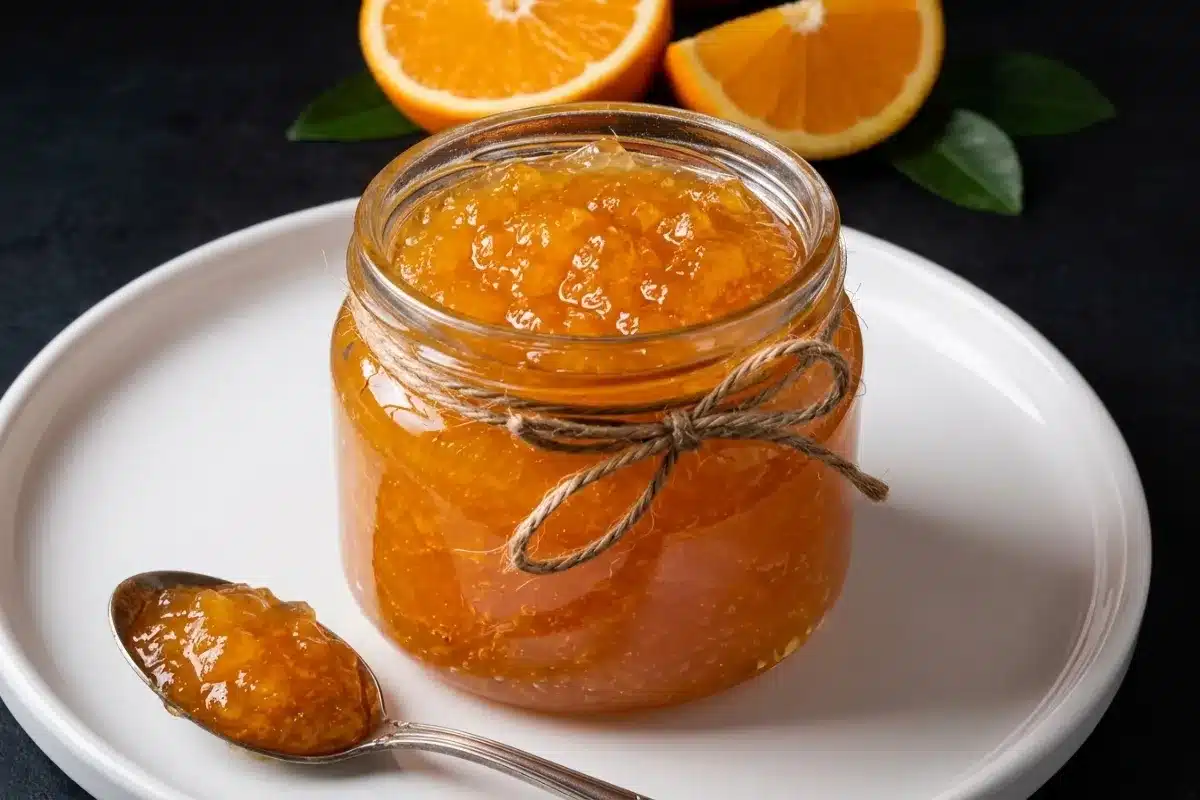
Bright, zesty, and bursting with sunshine, homemade orange jam is the perfect preserve to wake up your morning toast. Unlike store-bought varieties that rely heavily on commercial pectin and corn syrup, a traditional scratch-made batch captures the vibrant, bitter-sweet complexity of fresh citrus in every spoonful.
At inasrecipes.com, we love transforming a winter citrus haul into jars of golden perfection. You can master the art of natural fruit preserves with this recipe and fill your pantry with this recipe guide!
Italian Lemon Jam – Zesty, Sweet & Handcrafted Preserves
Table of Contents
Food Science: Pectin Bonds, Acid-Sugar Balance & Gelation
Making jam that sets perfectly without turning into rubber or syrup relies on a delicate chemical triad: pectin, acid, and sugar.
- Pectin Extraction: Oranges, particularly their white pith (albedo) and seeds, are naturally rich in pectin. Boiling the peels and seeds releases these long carbohydrate chains into the water.
- The Role of Acid and Sugar: In their natural state, pectin molecules repel each other. Adding sugar binds up the excess water, while the addition of acid (usually lemon juice) lowers the pH to the optimal range of 2.8 to 3.5. This neutralizes the negative charges on the pectin molecules, allowing them to bond and form a 3D gel network.
- The $105^{\circ}\text{C}$ ($220^{\circ}\text{F}$) Threshold: Water boils at $100^{\circ}\text{C}$, but a sugar syrup needs to reach $105^{\circ}\text{C}$ to achieve a 65% sugar concentration. Hitting this exact thermal benchmark guarantees the jam will set into a spreadable gel once cooled.
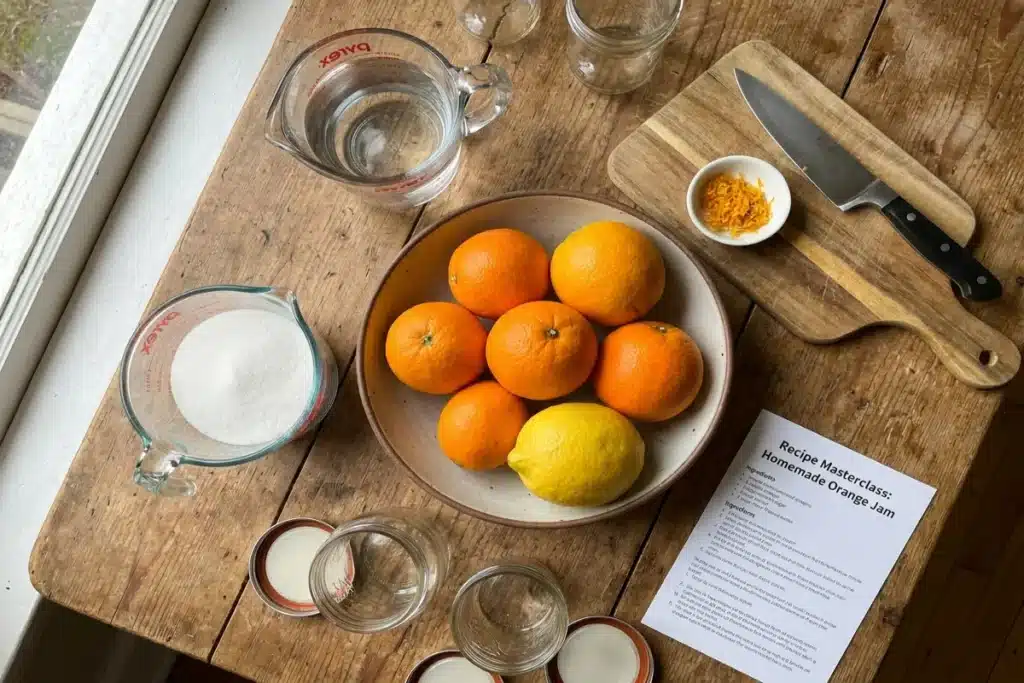
Recipe Masterclass: Homemade Orange Jam
Prep time: 30 min | Cook time: 1 hr 15 min | Yield: 3 to 4 Half-Pint Jars
Ingredients
- 4 to 5 medium Organic, unwaxed sweet oranges (Navel or Valencia)
- 1 large Lemon (for natural acid and extra pectin)
- 3 cups (600g) Granulated sugar
- 4 cups (940ml) Filtered water
Instructions
1.Prep the Citrus:20 mins.
Wash the oranges and lemon thoroughly. Cut off the ends and slice them as thinly as possible (leaving the peel on). Remove any seeds you find, but do not throw them away—tie them securely inside a small square of cheesecloth.
2.Soften the Peels:45 mins.
Place the sliced citrus, the cheesecloth bag of seeds (your natural pectin source), and the water into a large, wide, heavy-bottomed pot. Bring to a boil, then reduce the heat and simmer uncovered for 40 to 45 minutes until the peels are completely soft and translucent.
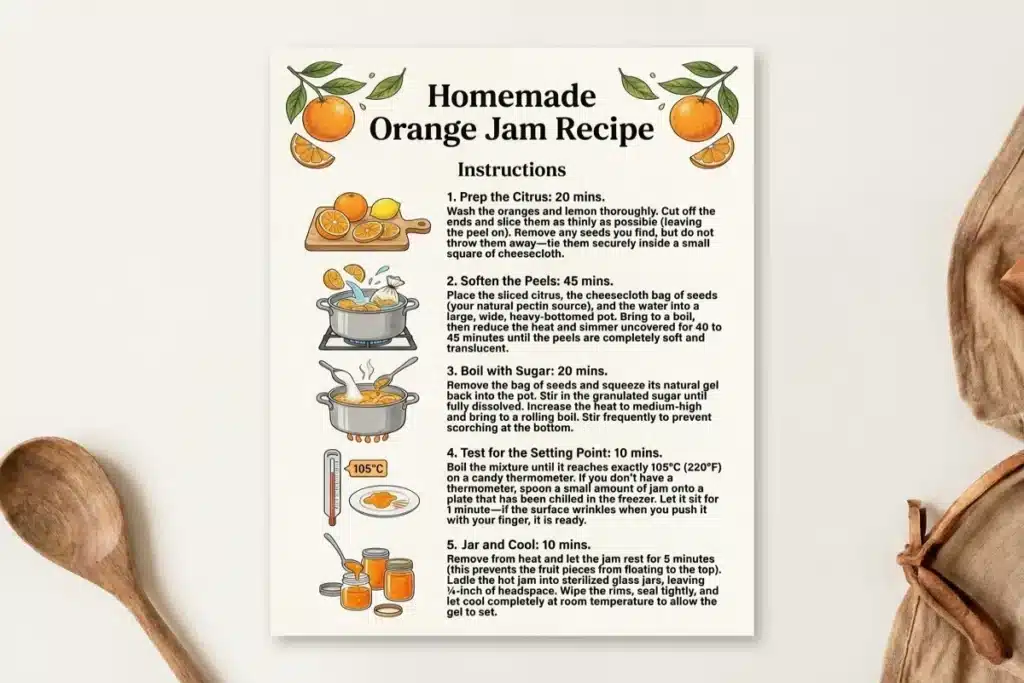
3.Boil with Sugar:20 mins.
Remove the bag of seeds and squeeze its natural gel back into the pot. Stir in the granulated sugar until fully dissolved. Increase the heat to medium-high and bring to a rolling boil. Stir frequently to prevent scorching at the bottom.
4.Test for the Setting Point:10 mins.
Boil the mixture until it reaches exactly 105°C (220°F) on a candy thermometer. If you don’t have a thermometer, spoon a small amount of jam onto a plate that has been chilled in the freezer. Let it sit for 1 minute—if the surface wrinkles when you push it with your finger, it is ready.
5.Jar and Cool:10 mins.
Remove from heat and let the jam rest for 5 minutes (this prevents the fruit pieces from floating to the top). Ladle the hot jam into sterilized glass jars, leaving ¼-inch of headspace. Wipe the rims, seal tightly, and let cool completely at room temperature to allow the gel to set.
Frequently Asked Questions (FAQ)
How long does orange jam last?
Properly canned and sealed orange jam stored in a cool, dark pantry will last for 1 to 2 years. Once a jar is opened, the seal is broken, and it should be kept in the refrigerator where it will stay fresh for 1 to 3 months. If you skip the water-bath canning process entirely and just use standard jars, keep them in the fridge immediately and consume within a month.
What are some tips for making homemade jam?
- Use Organic Fruit: Since you are eating the peels, using organic, unwaxed citrus prevents you from boiling down agricultural wax and pesticides into your jam.
- Don’t Toss the Seeds: Citrus seeds are packed with pectin. Tying them in a cheesecloth and boiling them with the fruit is a natural way to ensure a firm set without buying commercial pectin powder.
- Use a Wide Pot: A wide, shallow pot encourages faster water evaporation than a tall, narrow one, helping you reach the setting point without overcooking the fruit.
- The Chill Test: Always keep a few small plates in the freezer before you start cooking so you can quickly and accurately test the jam’s “wrinkle” set.
What are some common problems encountered when making marmalade?
- Runny Consistency: The most common issue. This happens if the jam never reached the $105^{\circ}\text{C}$ setting point, or if there wasn’t enough acid (lemon juice) to activate the pectin.
- Tough, Chewy Peels: This occurs if you add the sugar before the citrus peels have fully softened in the boiling water. Sugar hardens the cellular structure of the peel, locking it in a tough state.
- Sugar Crystallization: If the sugar is not completely dissolved over low heat before the mixture is brought to a rolling boil, the jam can develop a gritty, crystallized texture as it cools.
What is orange jam made of?
Authentic homemade orange jam requires only four foundational ingredients:
- Fresh Oranges: Using the whole fruit (pulp, juice, and rind).
- Fresh Lemon: Crucial for lowering the pH and adding extra natural pectin.
- Sugar: Acts as both a sweetener to balance the bitter citrus oils and a preservative to lower water activity.
- Water: To soften the dense citrus rinds before the sugar is introduced.
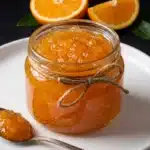
Homemade Orange Jam
- Total Time: 1 hour 45 minutes
- Yield: 3 to 4 half-pint jars 1x
- Diet: Vegan
Description
A bright, fragrant homemade orange jam made with whole citrus, natural pectin, and simple ingredients for a beautifully set, sweet and tangy preserve.
Ingredients
- 4 to 5 medium organic, unwaxed sweet oranges (Navel or Valencia)
- 1 large lemon
- 3 cups (600g) granulated sugar
- 4 cups (940ml) filtered water
Instructions
- Wash the oranges and lemon thoroughly. Cut off the ends and slice them as thinly as possible, leaving the peel on. Remove any seeds you find and tie them securely inside a small square of cheesecloth.
- Place the sliced citrus, the cheesecloth bag of seeds, and the water into a large, wide, heavy-bottomed pot. Bring to a boil, then reduce the heat and simmer uncovered for 40 to 45 minutes until the peels are completely soft and translucent.
- Remove the bag of seeds and squeeze its natural gel back into the pot. Stir in the granulated sugar until fully dissolved. Increase the heat to medium-high and bring to a rolling boil, stirring frequently to prevent scorching.
- Boil the mixture until it reaches exactly 105°C (220°F) on a candy thermometer. If you don’t have a thermometer, spoon a small amount of jam onto a chilled plate and let it sit for 1 minute. If the surface wrinkles when pushed with your finger, it is ready.
- Remove from heat and let the jam rest for 5 minutes. Ladle the hot jam into sterilized glass jars, leaving ¼-inch of headspace. Wipe the rims, seal tightly, and let cool completely at room temperature to allow the gel to set.
Notes
Use organic, unwaxed oranges since the peel is included. The citrus seeds provide natural pectin, helping the jam reach a beautiful gelled consistency.
- Prep Time: 30 minutes
- Cook Time: 1 hour 15 minutes
- Category: Sauce
- Method: Stovetop
- Cuisine: American
Nutrition
- Serving Size: 1 tablespoon
- Calories: 50
- Sugar: 12g
- Sodium: 1mg
- Fat: 0g
- Saturated Fat: 0g
- Unsaturated Fat: 0g
- Trans Fat: 0g
- Carbohydrates: 13g
- Fiber: 0.5g
- Protein: 0g
- Cholesterol: 0mg